The Fitness Industry Is Missing Its Biggest Opportunity
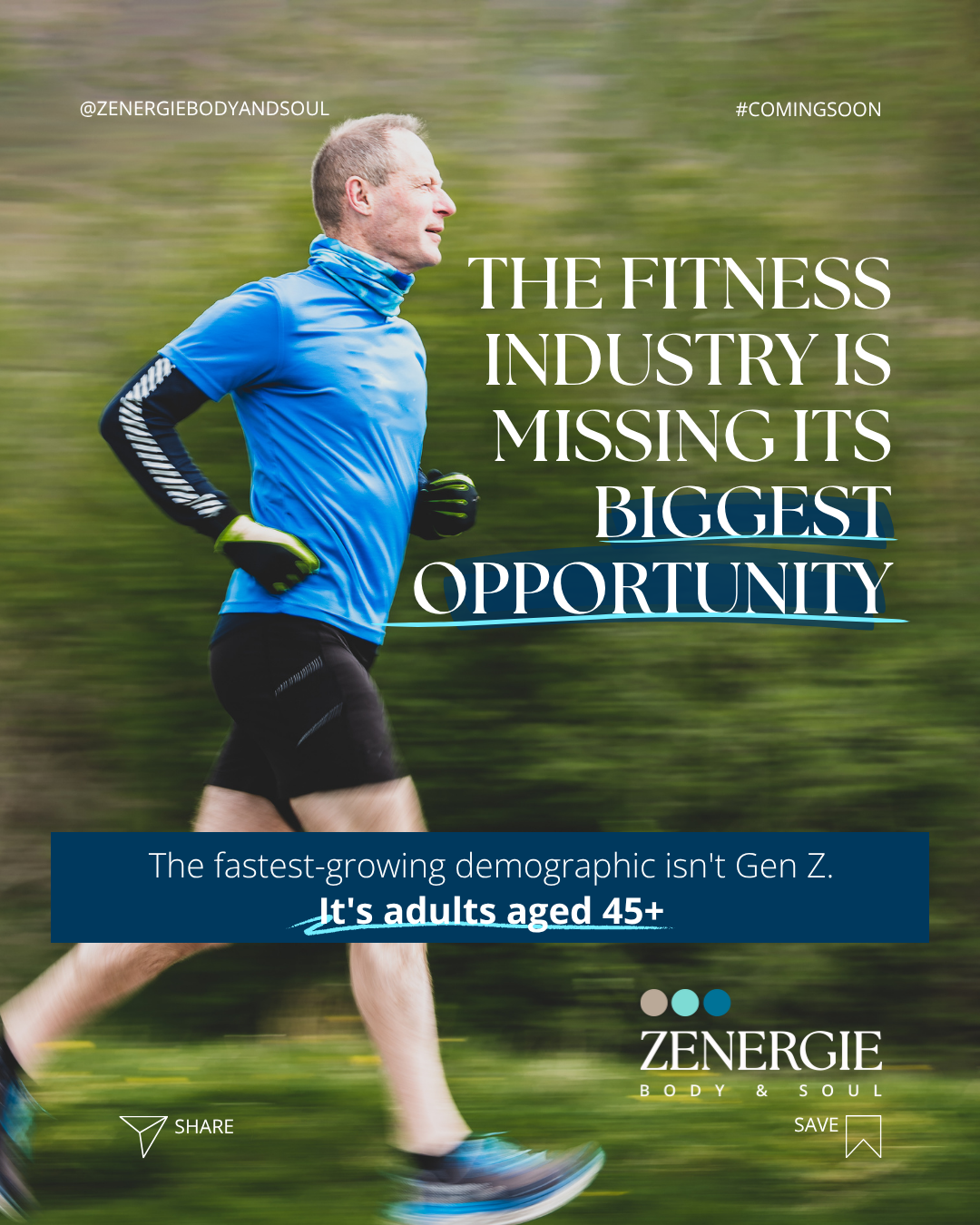
For years, the fitness industry has operated with a narrow focus on youth.
Marketing has prioritised younger bodies, high-intensity training, rapid transformation and performance-driven lifestyles. Gym environments, advertising campaigns and membership offers have often been designed around people who are already active, confident and familiar with fitness culture.
But the demographic reality is moving in a very different direction.
Across Europe and North America, populations are ageing rapidly. At the same time, adults over 45 are becoming more health-conscious, more active and more willing to invest in their well-being than any generation before them.
They are not simply looking to live longer.
They want to remain strong, mobile, independent and mentally engaged throughout the second half of their lives.
This is not a marginal audience.
It is one of the most important growth markets in the future of fitness and wellness.
The Industry Has Focused on the Wrong Consumer
Much of the fitness sector continues competing for the same young and already active audience.
Low-cost gyms, premium clubs, boutique studios and digital platforms may offer different experiences, but many still communicate through the same ideas: aesthetics, intensity, speed and visible physical transformation.
This creates an increasingly crowded market.
Brands compete for people who already understand training, already feel comfortable in gyms and already identify with fitness culture.
Meanwhile, a much larger audience remains underserved.
Adults over 45 may care deeply about their health, but their goals are often different.
They may want to preserve muscle, improve balance, protect mobility, reduce stress or maintain enough energy to enjoy work, travel, family and social life.
They may not be interested in becoming the strongest or leanest person in the room.
They want to remain capable.
The industry has spent years trying to attract younger members while overlooking the people whose needs are growing fastest.
Demographic Change Is Reshaping the Market
Population ageing is not a temporary trend.
It is a long-term structural transformation.
People are living longer, and the number of adults entering middle age and later life is increasing across many developed markets.
This change affects healthcare, housing, technology, travel and consumer behaviour.
It is also reshaping fitness.
A larger proportion of the population is beginning to think seriously about strength, mobility, prevention and long-term quality of life.
These consumers are not waiting until retirement to care about healthy ageing.
Many are beginning in their forties and fifties, when they first notice changes in energy, recovery or physical capacity.
They understand that the actions they take today will influence how they live twenty or thirty years from now.
That awareness creates demand for a different type of fitness experience.
Adults Over 45 Are Redefining Ageing
Previous generations were often encouraged to slow down as they aged.
Today’s adults are challenging that expectation.
They want to continue travelling, working, learning and participating in their communities. They want to remain physically independent and socially connected.
Ageing is no longer automatically associated with withdrawal.
It is increasingly viewed as a stage that can remain active, ambitious and meaningful.
This changes the role of fitness.
Exercise is no longer only a tool for changing appearance.
It becomes a strategy for preserving capability.
Strength training helps maintain muscle.
Mobility work supports comfortable movement.
Cardiovascular activity protects endurance.
Mindfulness and recovery help manage stress and maintain emotional balance.
Together, these elements support a more active and independent life.
The Second Half of Life Requires a Different Model
A fitness model designed for younger consumers cannot simply be reused without adaptation.
Adults over 45 may need more personalisation, guidance and confidence when beginning or returning to exercise.
They may have previous injuries, health concerns or years of inactivity to consider. They may recover differently and have less interest in extreme intensity.
This does not mean they need an easier or less ambitious programme.
They need a more intelligent one.
Training should begin from their current abilities and progress at an appropriate pace.
The experience should explain why each exercise matters and how it connects to long-term health.
Members should feel supported rather than judged.
The strongest opportunity lies in creating environments specifically designed around these needs.
Healthspan Is Becoming More Important Than Lifespan
People are increasingly familiar with the difference between lifespan and healthspan.
Lifespan is the total number of years lived.
Healthspan is the number of those years spent in good health, with sufficient strength, mobility and mental clarity to remain independent.
This distinction is transforming consumer priorities.
Living longer is valuable, but most people do not want those additional years to be defined by preventable weakness or limited mobility.
They want to remain capable for as long as possible.
This makes physical activity one of the most important investments they can make.
The fitness industry has an opportunity to become a central part of that investment.
But to do so, it must communicate in a language that reflects what people actually want.
Not simply weight loss.
Not simply performance.
But strength for life.
Strength Is the Foundation of Active Longevity
Muscle is one of the most important physical resources for healthy ageing.
It supports movement, metabolism, balance, joint stability and independence.
Without regular resistance training, muscle mass and strength may gradually decline from early adulthood onward.
This loss can affect everyday life long before it becomes medically significant.
Stairs feel harder.
Carrying shopping requires more effort.
Balance becomes less reliable.
Recovery from illness or inactivity becomes slower.
Strength training helps counter this decline.
It gives the body a reason to preserve and rebuild muscle.
For adults over 45, this is not about bodybuilding.
It is about maintaining the physical capacity to continue living on their own terms.
Mobility Protects Freedom
Mobility is closely connected to independence.
People need to be able to walk, bend, reach and change direction safely.
When mobility declines, life gradually becomes smaller.
Someone may stop travelling because walking through an airport feels too difficult. Another person may avoid certain social activities because stairs or uneven surfaces create concern.
These limitations affect more than the body.
They influence confidence, relationships and quality of life.
A future-ready fitness model must therefore include mobility, balance and functional movement alongside strength.
The goal is not only to improve performance inside the gym.
It is to protect freedom outside it.
Prevention Is Driving New Consumer Behaviour
Adults are becoming more proactive about health.
Instead of waiting for a problem to appear, they are looking for ways to reduce future risk and preserve quality of life.
This shift toward prevention is one of the strongest forces shaping the wellness economy.
People are investing in sleep, nutrition, stress management and exercise.
They want services that help them understand their bodies and make better long-term decisions.
Fitness businesses can play an important role in this transformation.
However, they must move beyond a transactional membership model.
Consumers increasingly expect guidance, personalisation and a clear connection between training and health.
The Most Affluent Audience Is Often Overlooked
The over-45 market is not only growing.
It also represents significant purchasing power.
Many adults in this age group have established careers, more financial stability and a greater willingness to invest in services that improve quality of life.
They may be less sensitive to the lowest possible price and more interested in trust, expertise and value.
They want to know that the programme is safe, relevant and professionally delivered.
This creates an opportunity for premium and specialised concepts.
A business designed around active longevity can offer a deeper value proposition than a standard gym membership.
It can become part of a person’s long-term health strategy.
Fitness Must Move Beyond Aesthetics
The traditional fitness industry has often made appearance the central measure of success.
This approach limits the market.
Many adults care more about how they feel and function than how closely they match an idealised image.
They want more energy.
They want to sleep better.
They want less pain and greater confidence.
They want to continue doing the activities they enjoy.
A fitness concept that communicates through these outcomes can connect with a much wider audience.
Progress becomes more meaningful when it is measured through daily life.
Can the person walk farther?
Can they lift more comfortably?
Do they feel more stable and energetic?
These are powerful results.
Personalisation Is Essential
Adults over 45 are not a single, uniform group.
One person may be highly active and experienced. Another may be returning after twenty years away from exercise.
Some may be managing chronic conditions. Others may be preparing for an active retirement.
This diversity requires personalisation.
Assessments, structured programming and attentive coaching help ensure that training reflects the individual.
Technology can also support this process.
It can help monitor progress, adapt resistance and create more precise programmes.
The objective is to combine human expertise with intelligent systems.
This allows members to receive an experience that feels personal without making the model impossible to scale.
Community Supports Long-Term Engagement
Community is another critical part of the opportunity.
Many adults are not only looking for exercise.
They are looking for connection.
A supportive environment can reduce intimidation and increase consistency. Members feel recognised, encouraged and accountable.
This is especially important for people who have never felt comfortable in conventional gyms.
A community-driven model transforms the experience.
People do not simply enter, train and leave anonymously.
They build relationships and become part of a shared routine.
This creates stronger emotional connection and better long-term retention.
The Industry Needs to Stop Treating Ageing as Decline
One of the greatest cultural barriers within fitness is the way ageing is represented.
Older adults are often shown as fragile, limited or in need of simplified activities.
This does not reflect the reality of the modern over-45 consumer.
Many are ambitious, capable and motivated.
They want to improve.
They want to be challenged.
The key is to provide appropriate challenge rather than unnecessary restriction.
A strong longevity concept treats ageing with realism but not pessimism.
It acknowledges that bodies change while reinforcing that strength, mobility and confidence can still be developed.
Active Ageing Is a Global Opportunity
The opportunity extends far beyond one city or country.
Ageing populations are creating similar needs across Europe, North America and many other regions.
Consumers are seeking solutions that help them stay active and independent.
Healthcare systems are under pressure and increasingly interested in prevention.
Investors are looking for business models aligned with durable demographic trends.
Active longevity sits at the intersection of these forces.
It combines social relevance, commercial potential and long-term demand.
That makes it one of the most compelling areas within the future wellness economy.
From Gym to Longevity Studio
The traditional gym is built around equipment and access.
A longevity studio is built around outcomes.
It focuses on strength, mobility, vitality and connection.
The environment feels guided rather than anonymous. Training is personalised rather than standardised.
Technology supports progress, while professionals help members understand what they are doing and why it matters.
This creates a more complete experience.
Members are not simply renting access to machines.
They are investing in their future physical capacity.
That difference is fundamental.
Zenergie Body & Soul and the Underserved Market
Zenergie Body & Soul was created to respond to this opportunity.
Its model focuses on active longevity rather than conventional fitness.
Strength training helps members preserve muscle and independence.
Mindfulness supports recovery and emotional well-being.
Community creates motivation, belonging and long-term consistency.
Intelligent technology helps personalise the training experience and make progress more visible.
The model is designed around adults who want to live better for longer.
It does not assume that members already understand fitness.
It provides the structure and support needed to begin.
A Business Built Around Structural Demand
The most resilient business opportunities are supported by forces that continue over time.
Population ageing is one of those forces.
The number of adults interested in prevention, mobility and healthspan will continue to grow.
This creates a broad and expanding customer base.
A concept aligned with that demand is not dependent on a short-lived trend.
It is positioned within a fundamental change in society.
This gives longevity-focused fitness strong long-term relevance.
Why Early Positioning Matters
The longevity fitness category is growing, but it remains open.
There is still no dominant global network that fully owns the space between fitness, prevention and active ageing.
This creates an important window of opportunity.
Early operators can establish trust, secure territories and build local communities before the market becomes crowded.
They can become the recognised reference for longevity-focused fitness in their region.
Once the category matures, competition will become stronger.
The greatest strategic advantage belongs to those who understand the shift early.
The Future Does Not Belong Only to Young Consumers
The wellness economy has spent decades chasing youth.
But the future of growth may belong to a very different audience.
Adults over 45 are increasing in number, purchasing power and health awareness.
They have clear needs and strong motivation.
What they often lack is a model designed specifically for them.
This is the gap the industry must address.
The opportunity is not simply to convince more people to join traditional gyms.
It is to create a new category that better reflects how people want to age.
Designing for the Second Half of Life
The second half of life should not be treated as a period of inevitable decline.
It can be a stage of continued growth, activity and contribution.
Fitness can help make that possible.
The right environment helps people build strength, protect mobility and remain confident.
It gives them tools to manage stress and stay socially connected.
Most importantly, it helps them continue participating in the life they value.
Designing for this audience is not a charitable exercise.
It is one of the strongest commercial opportunities in the market.
A More Human Definition of Success
The future of fitness needs a broader definition of success.
Success is not only a transformed body or a performance milestone.
It can be maintaining independence.
It can be reducing fear of movement.
It can be travelling, playing with grandchildren or returning to a favourite activity.
These outcomes are deeply valuable to consumers.
They also create stronger and more durable relationships with fitness brands.
A business that helps people protect their quality of life becomes more than a gym.
It becomes a trusted partner.
The Biggest Opportunity Is Already Here
The fitness industry does not need to wait for a new consumer trend.
The opportunity is already visible.
It is in the growing population of adults over 45.
It is in the demand for prevention, healthspan and active ageing.
It is in the millions of people who want to remain strong and independent but do not identify with traditional fitness.
The next leaders of the wellness economy will be the brands that recognise this reality and build for it.
They will not focus only on youth.
They will design for life.
The fitness industry is not missing a small niche.
It is missing its biggest opportunity.